


What is 1.3912 (Alloy36)
The material 1.3912 (Alloy 36) is a nickel-iron alloy with exceptionally low thermal expansion and high dimensional stability. It is ideally suited for precision applications in mechanical engineering, metrology, as well as toolmaking and apparatus engineering.
International identifiers
Properties of the material 1.3912 (Alloy36)
Mechanical properties
| Hardness | max. 146 HB |
| 0,2 % proof strength | 310 |
| Tensile strength | min. 490 Mpa |
| Elongation at break (transverse) | min. 42% |
| Impact energy (ISO-V) longitudinal | 132 J/cm² |
Physical properties
| Density | 8,1 |
| Electrical resistivity at 20°C (Ω mm2 /m) | 0,076 |
| Thermal conductivity at 20°C (W/m K) | 10,0 W/m · °C |
| Specific heat capacity at 20°C (J/kg K) | 0,6 – 1,4 |
| Magnetic properties | Ferromagnetic below the Curie temperature and non-magnetic at temperatures above it. |
Special properties
- Nickel–iron alloy with low thermal expansion
- Low coefficient of thermal expansion at temperatures down to -250 °C
- 1.3912 retains its thermal properties even under large temperature variations
Instructions for use
| Cold forming | During cold forming, the workpiece should be in the annealed condition. 1.3912 exhibits work hardening similar to austenitic stainless steels. |
| Cold heading | n/a |
| Open-die and closed-die forging | yes |
| Machining | The chip-forming machining characteristics of 1.3912 are similar to those of austenitic stainless steels. |
Calculate the weight quickly and easily
Heat treatment 1.3912
| Forging | 1.3912 can be hot-formed in the temperature range between 1050 and 800°C. |
| Welding | Similar recommendations apply as for other nickel alloys. |
| Soft annealing | Soft annealing should be carried out at temperatures between 820 and 900°C, followed by air cooling. |
| Stress relief annealing | Stress relief annealing is performed at temperatures below 360°C. |
| Hardening | Not suitable for hardening. |
Chemical composition of 1.3912
| 1.3912 | C | Si | Mn | P | S | Cr | Mo | Ni | Co | N |
|---|---|---|---|---|---|---|---|---|---|---|
| min. | 35,0 | |||||||||
| max. | 0,10 | 0,50 | 0,50 | 0,025 | 0,025 | 0,5 | 0,5 | 37,0 | 0,5 | 0,10 |
Areas of application for 1.3912
Instructions for use
- Precision components for maximum dimensional accuracy
- Cryogenic applications down to approx. -260 °C
- Thermally stable components with minimal thermal expansion
- Mechanical and plant engineering
- Metrology and precision engineering
- Tool and mould making
- Components with high requirements for strength and toughness
Areas of application
- Production, storage and transport of liquefied gases
- Medical technology
- Measuring and control equipment for temperatures below −200 °C
- Thermostats and cryogenic applications
- Optical and laser-based components
- Tools for the production of composite components
- Aviation technology
- Aerospace technology
- Submarine construction
Form of supply and availability of 1.3912
In stock
Available for immediate delivery from stock!
Form of supply
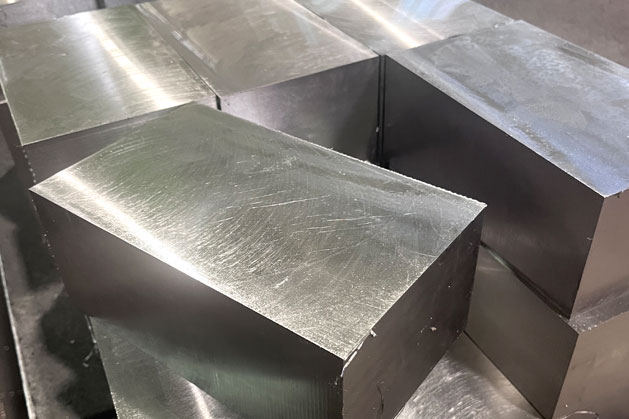
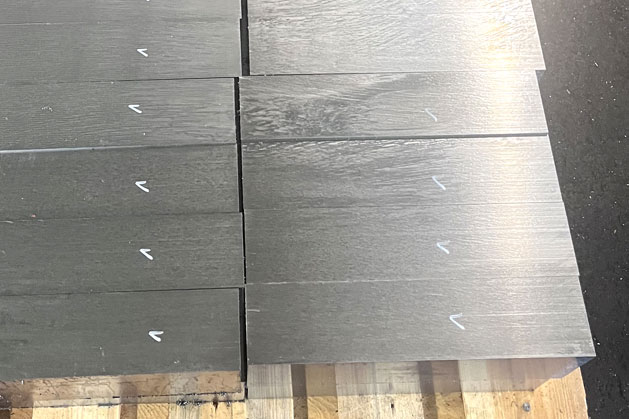
Flat steel, forged, solution-annealed/quench-hardened
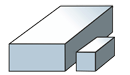
Advantages of saw cut
The processing with the saw is a mechanical processing of the material, which results in a significantly lower unintended deformation and increased hardness for the existing structure, such as the thermal cutting.
Thus, the machined workpiece has a homogeneous structure even at the edge, which does not change in the continuation of the material.
This circumstance allows immediate finishing of the workpiece with milling or drilling . So it is not necessary to anneal the material or make a similar operation beforehand.
Frequently asked questions about material 1.3912:
It exhibits virtually no thermal expansion when exposed to heat or cold (within a temperature range of approx. −250 °C to +200 °C).
In aerospace (satellites and components), laser system manufacturing, and measuring and control equipment for the optical industry.
The material is traditionally available as sheet, strip steel or round bar. However, our absolute specialty is precision saw cutting from forged blocks. We saw your required dimensions directly from solid, forged Invar blocks.
This method offers a decisive quality advantage: the material is extremely low-stress, which means that your components are far less likely to distort during subsequent machining compared with conventional sheet cut-outs.
Notice: Specifications contained in following data sheet are provided as a description, liability is excluded!