


What is 1.2316 (X38CrMo16)
If you are looking for an alternative to 1.2316 with higher wear resistance, 1.4122 is a high-performance solution. This material combines good corrosion resistance with high hardness, making it particularly suitable for heavily stressed components in the food industry, mechanical engineering, and pump and valve applications. Its chemical composition and properties are similar to those of grade 1.2316. This steel is popularly known as AISI 420.
International identifiers
Properties of the material 1.2316 (X38CrMo16)
Properties
| Weldability | bad |
| Machinability | 4 (1 = very bad - 10 = good) |
| Polishability | good |
| Corrosion class 0 - 5 | 2-3 (0 = weak - 5 = good) |
Mechanical properties
- vergütet max. 325 HB
Calculate the weight quickly and easily
Heat treatment 1.2316
Soft Annealing
- Temperature: 760–800°C
- Cooling: in the furnace
- Annealed hardness: max. 230 HB
Hardening
- Temperature: 1020–1050°C
- Quenching: in oil or in a salt bath at 500–550°C
- Hardness after quenching: 49 HRC
Tempering
- 100°C: 49 HRC
- 200°C: 47 HRC
- 300°C: 46 HRC
- 400°C: 46 HRC
- 500°C: 47 HRC
- 600°C: 32 HRC
Chemical composition of 1.2316
| 1.2316 X38CrMo16 | C | Si | Mn | P | S | Cr | Mo | Ni | V |
|---|---|---|---|---|---|---|---|---|---|
| min. | 0,33 | 15,5 | 0,8 | ||||||
| max. | 0,45 | 17,5 | 1,3 |
Areas of application for 1.2316
Instructions for use
- For highly stressed components
- When a combination of good corrosion resistance and high hardness is required
- For applications involving chemically aggressive or acid-releasing thermoplastics
- For use in the food industry
- When increased wear resistance is required
- Quenched and tempered condition: max. 325 HB
Areas of application
- Plastic injection molds
- Extrusion tools
- Press molds
- Machine components for the food industry
- Pump and compressor manufacturing
- Compressor components
- Pump and valve technology
- Mechanical engineering
Form of supply and availability of 1.2316
In stock
Immediately available from stock
Form of supply
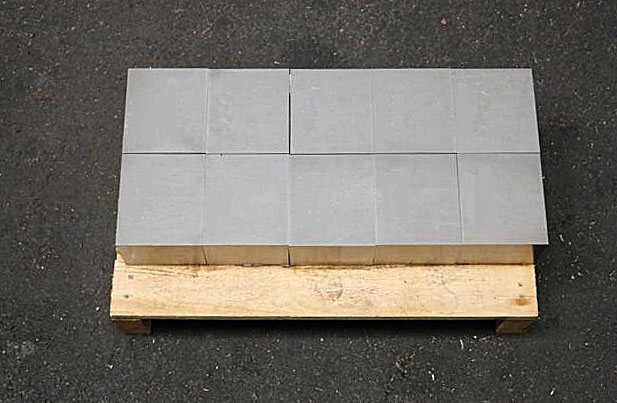
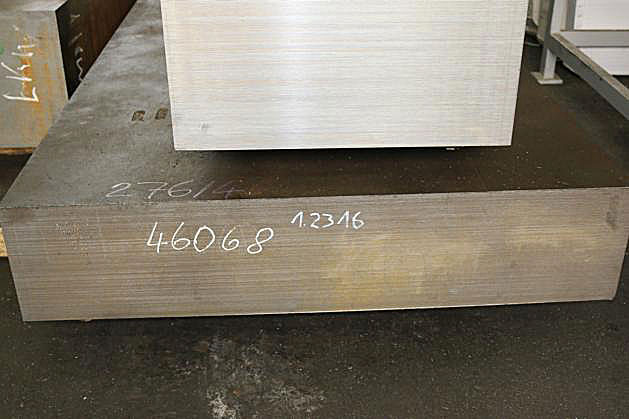
Flat, forged, quenched and tempered

Sawn blank
The processing with the saw is a mechanical processing of the material, which results in a significantly lower unintended deformation and increased hardness for the existing structure, such as the thermal cutting.
Thus, the machined workpiece has a homogeneous structure even at the edge, which does not change in the continuation of the material.
This circumstance allows immediate finishing of the workpiece with milling or drilling . So it is not necessary to anneal the material or make a similar operation beforehand.
Notice: Specifications contained in following data sheet are provided as a description, liability is excluded!