


What is 1.2312 (40CrMnMoS8-6)
1.2312 standard plastic mold steel to cross-sections up to 400 mm for plastic- and die casting-molds with medium dimensions. With Sulphur additive for a better machinability.
Mold frame, IHU Tools.
International identifiers
Properties of the material 1.2312 (40CrMnMoS8-6)
Properties
| Weldability | bad |
| Machinability | 5 (1 = very bad - 10 = good) |
| Polishability | not suitable |
| Graining suitability | not suitable |
Material grade 1.2312 offers good dimensional stability and toughness, provides wear resistance after nitriding, and maintains uniform hardness in large cross-sections.
Mechanical properties
quenched and tempered 280 - 325 HB
Physical properties
| Density in kg/dm3 | 7,85 |
| Electrical resistivity at 20°C (Ω mm2 /m) | 0,19 |
| Thermal conductivity at 20°C in W/(m K) | 34,5 |
| Specific heat capacity at 20°C (J/kg K) | 460 |
Calculate the weight quickly and easily
Heat treatment 1.2312
Soft annealing: 710–740°C, followed by furnace cooling
Stress relieving: 650–680°C, followed by furnace cooling; recommended for complex workpieces and extensive machining
Hardening: 840–870°C, followed by cooling in oil, a hot bath or air
Tempering: After hardening to reduce internal stresses
Electrical discharge machining (EDM): Possible in the hardened and tempered condition; followed by stress relieving at 550°C
Hot forming: 1050–850°C, followed by slow cooling
Forging: Typical temperature range of 1050–850°C
Chemical composition of 1.2312
| 1.2312 40CrMnMoS8-6 | C | Si | Mn | P | S | Cr | Mo | Ni | V |
|---|---|---|---|---|---|---|---|---|---|
| min. | 0,35 | 1,4 | 0,05 | 1,4 | 0,15 | ||||
| max. | 0,45 | 1,6 | 0,10 | 2,0 | 0,25 |
Areas of application for 1.2312
Instructions for use
- When good machinability and workability in the quenched and tempered condition are required.
- When high dimensional stability and uniform strength are essential.
- For plastic moulds and die-casting moulds of medium dimensions, with cross-sections of up to approx. 400 mm.
- When minimal distortion during hardening is required, including for large injection moulds.
Areas of application
- Plastics industry
- Plastic moulds for thermosetting and thermoplastic materials
- Injection moulds
- Die-casting moulds
- Mould frames
- Internal high-pressure forming (IHU) tools
- Mechanical engineering
- Structural components
Form of supply and availability of 1.2312
In stock
Immediately available from stock
Form of supply
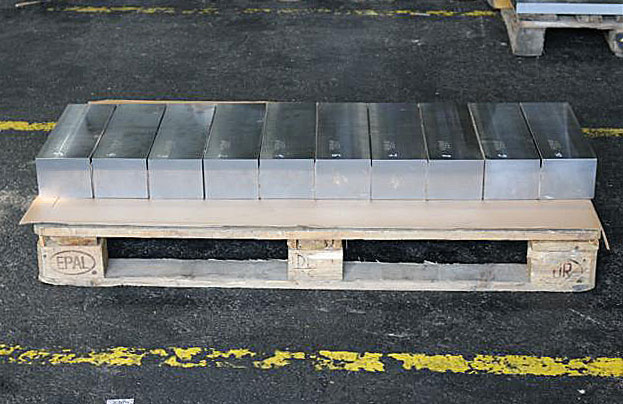
Flat, forged, quenched and tempered
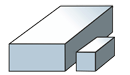
Sawn blank
The processing with the saw is a mechanical processing of the material, which results in a significantly lower unintended deformation and increased hardness for the existing structure, such as the thermal cutting.
Thus, the machined workpiece has a homogeneous structure even at the edge, which does not change in the continuation of the material.
This circumstance allows immediate finishing of the workpiece with milling or drilling . So it is not necessary to anneal the material or make a similar operation beforehand.

Frequently asked questions about material 1.2312:
Yes, thanks to its sulphur content, it offers very good machinability and allows high cutting speeds.
It has moderate weldability (caution is required due to its sulphur content) and can be readily nitrided to increase its wear resistance. The sulphur content (0.05–0.1%) ensures excellent milling and drilling properties.
No. Due to its sulphur content, its polishability is moderate to poor, making it unsuitable for high-gloss applications.
1.2311 (40CrMnMo7) contains no sulphur addition and offers better toughness and polishability, but is somewhat more difficult to machine. 1.2312 (40CrMnMoS8-6) contains sulphur (S), which significantly improves machinability (milling and drilling) but has a negative impact on polishability and suitability for high-gloss applications.
Notice: Specifications contained in following data sheet are provided as a description, liability is excluded!