


What is 1.2083 (X40Cr14)
This is a corrosion-resistant plastic mold steel. It is thermosetting; low distortion with high hardness and can be well polished. The properties and chemical composition are comparable with the material 1.4034.
1.2083 is also known under the classification AISI 420.
International identifiers
Properties of the material 1.2083 (X40Cr14)
Properties
| Weldability | bad |
| Machinability medium | 5 (1 = poor - 10 = good) |
| Polishing | very good |
| Corrosion class | 1 (0 = schwach - 5 = gut) |
| Wear resistance | high |
Soft annealed max. 241 HB
Hardened and Tempered 332-369 HB
Physical properties
| Density in kg/dm3 | 7,80 |
| Young's modulus (103 MPa) | 200 |
| Thermal conductivity at 20°C in W/(m K) | 17,0 |
| Specific heat capacity at 20°C in J/(kg K) | 460 |
Processing
Polishing: The polishing of material grade 1.2083 is possible in soft annealed and hardened condition. In this case, a good preparation of the surfaces is decisive for a good polish.
Etching: Good photo etching is given. (Scar)
Erosion: In the hardened and tempered state, the material 1.2083 can be eroded. Afterwards, it is necessary to depressurize again approx. 20°C below the last tempering temperature.
Nitriding and hard chrome plating is not common with this material.
Calculate the weight quickly and easily
Heat treatment 1.2083
Low-stress annealing: A temperature between 600°C and 650°C should be considered for stress-relieving annealing. Thereafter, a furnace cooling takes place.
Soft annealing: The material 1.2083 should be soft annealed at temperatures of 760°C - 800°C. Subsequently, a slow cooling in the oven must be done.
Hardening: Hardening takes place at 1000°C - 1050°C. This is followed by cooling in air, oil or in a warm bath.
Chemical composition of 1.2083
| 1.2083 X40Cr14 | C | Si | Mn | P | S | Cr | Mo | Ni | V |
|---|---|---|---|---|---|---|---|---|---|
| min. | 0,36 | 12,5 | |||||||
| max. | 0,42 | 1,00 | 1,00 | 0,030 | 0,030 | 14,5 |
Areas of application for 1.2083
Instructions for use
- Suitable for applications involving chemically aggressive and acid-releasing plastics
- Particularly suitable where high resistance to aggressive plastic media is required
- Can be used in areas subject to high chemical stress
Areas of application
- Thermosetting and thermoplastic materials
- PVC and aminoplastics
- Plastic injection mould inserts
- Machine parts for the food industry
Form of supply and availability of 1.2083
In stock
Available for immediate delivery from stock
Form of supply
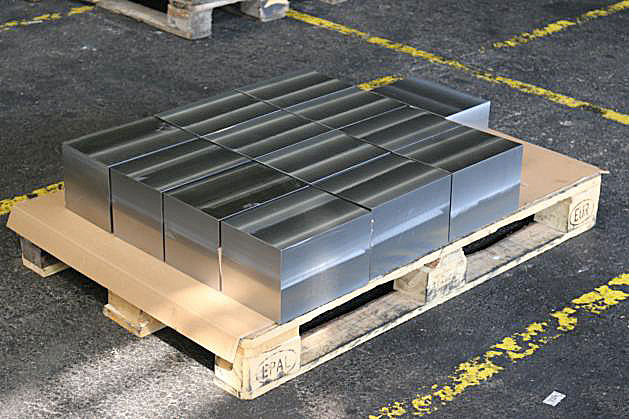
Flat, forged, annealed, hardened and tempered

Sägeszuschnitt
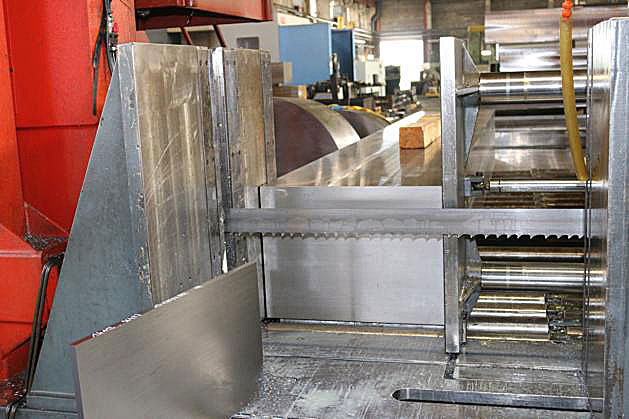
The processing with the saw is a mechanical processing of the material, which results in a significantly lower unintended deformation and increased hardness for the existing structure, such as the thermal cutting.
Thus, the machined workpiece has a homogeneous structure even at the edge, which does not change in the continuation of the material.
This circumstance allows immediate finishing of the workpiece with milling or drilling . So it is not necessary to anneal the material or make a similar operation beforehand.
Frequently asked questions about material 1.2083:
In the hardened and tempered condition, the material typically achieves a hardness of approx. 53 to 56 HRC.
No, the weldability of 1.2083 is considered poor due to its high carbon and chromium content.
ESR stands for Electroslag Remelting. This special grade is extremely pure, contains very few inclusions and allows mirror-like polishing without "breakouts".
Notice: Specifications contained in following data sheet are provided as a description, liability is excluded!